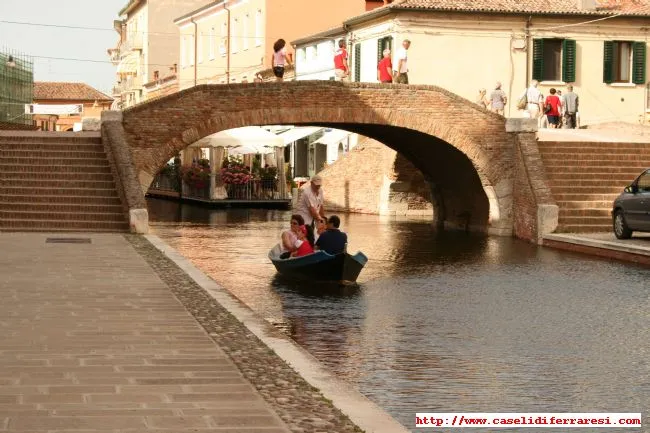

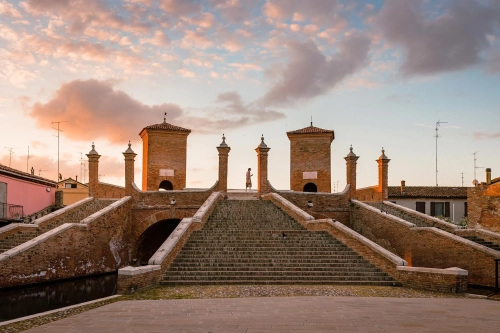
Comacchio, a small picturesque town also known as Little Venice, has ancient origins. It dates back to the Middle Ages when the initial settlement was established on a group of 13 tiny islands divided by canals, accessible only by boat. This remained the case until 1821 when the town was connected to the mainland by bridges. Today, Comacchio is a charming and picturesque lagoon town whose historic center can be visited by traditional boats called “batane,” small flat-bottomed boats that until a few decades ago were the normal means of transport for the inhabitants.
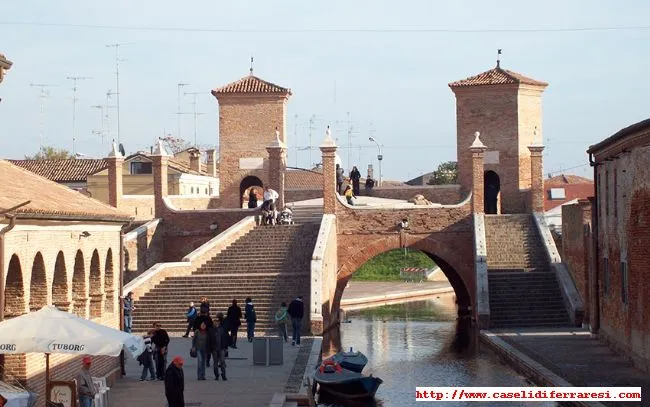
A town rich in art and charm, its symbol is the architectural complex of the Trepponti. The Trepponti bridge consists of five wide staircases (three at the front and two at the rear), culminating in a Istrian stone floor. Its unique vault serves as a crossroads for four other canals that branch off from here to the city, surrounding and crossing it.
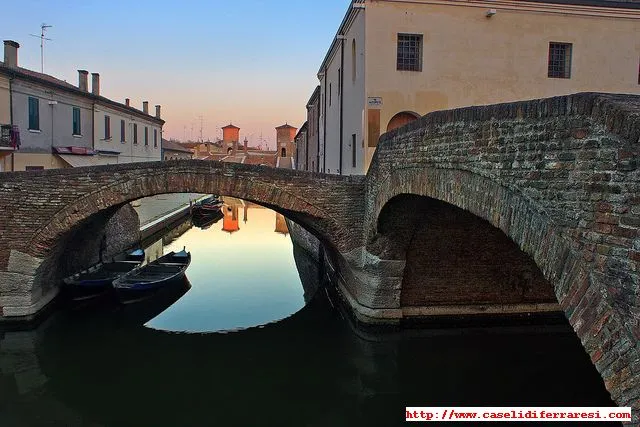
Starting from the Trepponti bridge, through the navigable canal, you arrive directly at the Ponte degli Sbirri or delle carceri (which takes its name from the ancient prisons next to it).
Next to it is Palazzo Bellini, a sumptuous 19th-century two-story building, home to an aristocratic family from Comacchio, which now houses the Contemporary Art Gallery, the Historical Archive, the library, and the offices of the Department of Cultural Institutions.
Opposite Palazzo Bellini stands the imposing neoclassical Antico Ospedale della città (Old City Hospital). The hospital, which was in operation until the mid-1970s, has recently been restored and currently hosts exhibitions and will house the newly established Museum of Human Cultures in the Po Delta.
Near Palazzo Bellini, inside two old renovated warehouses, part of the complex of the ancient prisons of Comacchio, is the Museum of the Roman Ship's Cargo. The museum houses the wreck of a commercial ship from the imperial era, which resurfaced in 1989 during the drainage of a canal. The ship, in an exceptional state of preservation, still contained all its cargo (amphorae with foodstuffs, lead ingots, and some small lead votive temples).
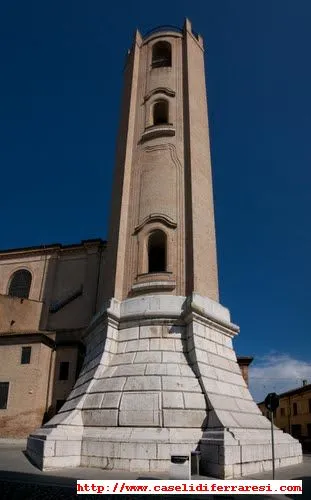
In the heart of the city, in Piazza XX Settembre, stands the majestic Cathedral of San Cassiano, named after the patron saint of the city and the diocese. Next to it stands the Bell Tower, built on a huge Istrian stone base. Not far away, in the center of the city, we find the Loggia dei Mercanti o Del Grano, set on the sides of what was once the splendid Ponte di Piazza before its demolition in the 19th century. It was built as a grain store for the poor.
On the same axis, at the intersection of the main city streets, stands the isolated Clock Tower, built around 1330, which collapsed in 1816 and was rebuilt in 1824. It also rests on an Istrian stone base and has a niche in the center that houses a stone statue of the Madonna and Child.
Also noteworthy is the Loggiato dei Cappuccini, a long portico formed by 142 arches supported by as many marble columns, through which you can reach the Church of Santa Maria in Aula Regia.